
What Is PNP Bill Payment on a Bank Statement?
Written By Malina Joseph, Legal Writer at Best US Lawyers Org | Last Updated: September 17, 2026
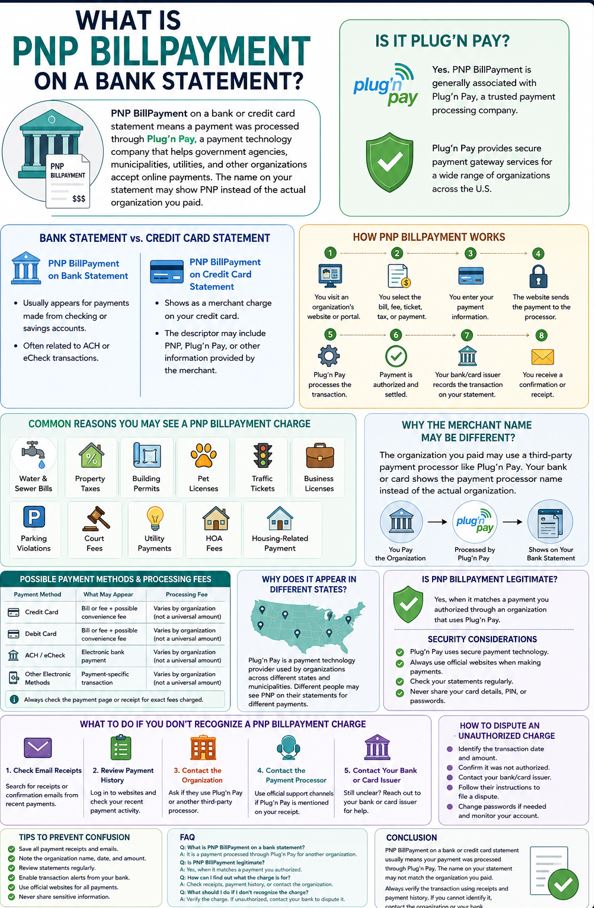
If you notice PNP Bill payment On Bank Statement, you may wonder whether you made a payment to a company called PNP. In many cases, the answer is no. A PNP BillPayment entry can refer to a transaction processed through Plug’n Pay, a payment-processing company that provides electronic payment technology for merchants and organizations.
This means the name shown on your bank or credit card statement may identify the payment processor rather than the government agency, municipality, utility, or other organization you actually paid.
Understanding the PNP billpayment meaning can make it much easier to identify the transaction and determine whether it is a payment you authorized.
What Does PNP Bill Payment Mean?
PNP Bill Payment generally refers to a payment that has been processed through Plug’n Pay or a merchant system using Plug’n Pay’s payment technology. Plug’n Pay provides payment gateway and electronic transaction services that allow organizations to accept payments online.
Plug’n Pay has documentation that says it can handle credit card payments and online check or ACH transactions.
The Plug’n Pay technology can also be used on websites and other things.
When you see Plug’n Pay bill payment on your bank statement it does not mean Plug’n Pay sold you something.
It just means Plug’n Pay helped with the payment you made to another company.
The company that you actually paid depends on who the merchant’s what the payment details are, for your Plug’n Pay transaction.
PNP Bill Payment on Bank Statement vs. Credit Card Statement
The basic meaning is similar, but the way the transaction appears can differ.
PNP Bill Payment on a Bank Statement
If the payment was made from a checking or savings account, your bank statement may show a PNP-related description associated with an electronic payment or ACH transaction.
Plug’n Pay’s documentation specifically supports online-check/ACH payment methods, so a transaction processed through its system can involve a bank account rather than a credit card.
PNP Bill Payment on Credit Card
If you used a credit card to make a payment the charge might show up as a merchant charge on your card statement. The description on the statement could include PNP, Plug’n. Other details given by the merchant or the payment system.
Plug’n Pays guides also say that the merchant can share information linked to the customers card transaction like the name and billing address that were used when processing the payment.
No matter which situation it is the key thing is that the description, on the statement might not match the organization you think you paid.
How Does PNP Bill Payment Work?
The process is usually straightforward:
- You visit an organization’s website or online payment portal.
- You select the bill, fee, ticket, tax, license, or other payment you need to make.
- You enter your payment information.
- The website sends the transaction through its payment-processing system.
- Plug’n Pay or another payment component processes the transaction.
- The payment is authorized and submitted for settlement.
- Your bank or card issuer records the transaction on your statement.
- You receive a confirmation or receipt if the organization has enabled one.
Plug’n Pay’s documentation describes transaction authorization, settlement, returns, and transaction records as part of its payment-processing system.
Why Might You See a PNP BillPayment Charge?
There are many possible reasons for a PNP bill payment charge. The exact possibilities depend on which organizations in your area use the payment platform.
For example, you may have recently paid:
- Water or sewer bills
- Property taxes
- Building permits
- Pet licenses
- Traffic tickets
- Business licenses
- Parking violations
- Court fees
- Utility payments
- HOA fees
- Housing-related payments
These are examples of the types of bills or fees that organizations may collect through online payment systems. You should not assume that every PNP transaction relates to a government agency, however. Plug’n Pay also provides payment technology for businesses and other organizations.
Why Is the Merchant Name Different?
People look for information on PNP bill payment because the name on the bill does not match the company they think they paid.
This happens because when you make a payment it involves a lot of parties. The company you pay might use another company to handle the payment
For instance let us say you pay a fee to your government through their website.
You think you are paying the government. The bank shows a different name, which is the payment processor.
PNP bill payment allows companies to share information about the transaction. The bill can have more details than just the name of the payment processor.
This is why the name on the bill might not be the same, as the company you think you paid it is actually the PNP bill payment processor.
Can a PNP Bill Payment Include a Processing Fee?
Some organizations charge a separate convenience or processing fee when customers choose to pay electronically.
However, there is no single universal PNP processing fee that applies to every transaction. Fees can depend on the organization, payment method, local rules, and the arrangement between the merchant and payment provider.
A simple way to understand the possibilities is:
| Payment method | What may appear | Processing fee |
| Credit card | Bill or fee + possible convenience fee | Depends on the organization |
| Debit card | Bill or fee + possible convenience fee | Depends on the organization |
| ACH/eCheck | Electronic bank payment | Depends on the organization |
| Other electronic methods | Payment-specific transaction | Depends on the organization |
Is PNP Bill Payment Legitimate?
A PNP BillPayment entry is okay when it is for a payment you really made through a company that uses Plug’n Pays payment system.
Plug’n Pay is a known company that helps with payments and they have information on how they process payments and they also have people who can help you with problems.
Just because you see the words “PNP” does not mean that the transaction is real. You should always check if you do not know what a transaction is for.
Do not just look at the name of the store where you made the purchase. You should also look at how much the transaction was, for and when it happened and compare that to your bills and receipts and emails and history of payments.
What to Do If You Don’t Recognize a PNP Bill Payment Charge
If you do not recognize a PNP bill payment on bank statement, don’t panic. Start by trying to identify the underlying payment.
1. Check Your Email Receipts
Search your email for terms such as:
- PNP
- Plug’n Pay
- Bill Payment
- Payment confirmation
- Receipt
- Transaction
- The name of the organization you recently paid
Also check your spam or junk folder.
2. Review Your Payment History
Log in to websites where you recently made payments. Check your history for the same amount and date.
Pay particular attention to government, utility, property, housing, licensing, and other service accounts.
3. Contact the Organization You Paid
If you think the payment is for a bill, ticket, tax, permit or something like that you should get in touch with the organization that usually takes that kind of payment.
You need to ask them if they use Plug’n Pay or some other company to process payments.
Also give them the date and amount of the payment.
4. Contact the Payment Processor When Appropriate
If the receipt or payment page says Plug’n Pay is the processor you can go to their website to find out how to get in touch with them.
They have a section on their website with contact information for people who have questions.
You can use this to ask about the payment.
5. Contact Your Bank or Card Issuer
If you still do not know what the payment is for especially if you do not think it was authorized you should contact your bank or the company that issued your card.
You can call the phone number on the back of your card. Look on your banks website for how to get in touch with them.
Ask them about the payment. Do what they say to report a payment that you did not authorize.
How to Dispute an Unauthorized PNP Bill Payment
If you determine that you did not authorize the transaction, report it to your bank or card issuer as soon as possible.
The general process is:
- Identify the transaction date and amount.
- Confirm that nobody authorized to use the account made the payment.
- Contact your bank or card issuer through an official channel.
- Tell them you believe the transaction is unauthorized.
- Follow their instructions for submitting a dispute or fraud claim.
- Change relevant passwords if you suspect your online account was compromised.
- Monitor your statements for additional unfamiliar transactions.
The exact dispute process and deadlines can vary depending on the type of account and transaction, so follow the instructions provided by your financial institution.
Frequently Asked Questions About PNP Bill Payment
Is PNP Bill Payment legitimate?
It can be legitimate. Plug’n Pay is a company that helps people make payments but if you see a PNP transaction that you do not recognize you should check your receipts and payment history to make sure it is real.
Why is PNP Bill Payment showing on my credit card?
You might see PNP BillPayment on your credit card because a company you paid used Plug’n Pay to process the payment. The name on your statement does not have to be the same as the company you were paying.
What company is behind PNP BillPayment?
PNP BillPayment is related to a company called Plug’n Pay Technologies. They help other companies process payments and provide technology for payments.
How can I find out what a PNP Bill Payment charge is for?
To figure out what a PNP BillPayment charge is for start by looking at the amount and date of the payment. Then check your email for receipts look at your payment history and see if you made any payments for things like utilities, property or licenses.
Can I get a refund for a PNP Bill Payment?
Refunds are usually determined by the organization that received the payment. Contact the organization for more information about their refund policy.
Does PNP Bill Payment mean I was charged an extra fee?
A transaction that shows PNP may include the amount of the bill you were paying and other fees charged by the biller or payment method. Look over your receipt to see if fees were charged.
Why does my bank statement show PNP instead of the company I paid?
A payment processor will usually show up on your statement if the organization you paid is not a bank. Plug’n Pay will show up as PNP.
What types of payments can appear as PNP Bill Payment?
Depending on the organization using the service, the transaction may relate to payments such as:
- Water or sewer bills
- Property taxes
- Permits and licenses
- Pet licenses
- Traffic tickets
- Other government or municipal fees
Conclusion
A PNP bill payment on bank statement is generally a payment transaction associated with Plug’n Pay’s payment-processing technology. The PNP wording may appear instead of the name of the government agency, municipality, utility, business, or other organization that actually received your payment.
Disclaimer
This article provides general informational content and is not financial, banking, or legal advice. The legal rights and procedures applicable to a particular transaction depend on the payment method, account type, circumstances, and applicable law.
